Friday, 15 April 2016

Vegan RPGs: Hear me out... wait! Don't go!

Here at 103% Complete we strive to fill all the niches that everybody else misses, which seriously eats into our juicy clickbait revenues. As the title of this post suggests, we're looking to inform and entertain the audience intersection between those who are interested in the politics of veganism and those who enjoy videogames enough to read what I'd (generously) regard as an obscurely popular video game blog.

Available on the app store

Because the OED isn't very nuanced in its definition of veganism, I'm going to take the definition put forward by The Vegan Society itself:

'Veganism is a way of living which seeks to exclude, as far as is possible and practicable, all forms of exploitation of, and cruelty to, animals for food, clothing or any other purpose.'

So what does this have to do RPG games? I'll tell ya. The popularity of RPGs and MMOs with an RPG bent to them have resulted in the development and maintenance of increasingly complex game worlds, with rich character creation, field combat and crafting systems already the norm in the big budget titles. The developers behind such games want to create a world into which the player can inject as much of their creativity and personality into their gameplay as they wish to. These varying degrees of expression are part of the huge draw these games have. 


The possibilities are endless
We see in the Mass Effect series that notions of gender identity need not be heteronormative, In Eve Online you can carve out a niche as an operative in a megacorporation and have an equally valid experience as someone who exclusively engages in mining or space piracy. Even games like Minecraft without strict metrics for victory and success invite roleplaying servers to pop up. But (and this is where I get to the vegan bit, I promise) could you exist and thrive in such a world as someone who actively would rather not exploit in-game animals wherever possible? Even if you're not a vegan in real-life it may be an interesting roleplay option. I know people who roleplay being a shopkeeper in The Elder Scrolls IV: Oblivion, which I remind you is a single player game where shop ownership is not coded into the game. Being a vegan mage is far from the oddest roleplay option out there.    

So how can a would-be vegan player fall foul of animal exploitation in their RPG gameplay? Let's look at some common categories.

Food: Diet is the obvious place to start with real life vegans but in many RPGs, keeping on top of your characters' nutrition isn't integral to being competitive. Topping up your HP and MP can usually be handled with spells, potions or just a good night's sleep. However, more often than not it is the slabs of beef and wheels of cheese that provide the greatest benefit as consumables in games such as in Contact and Punch Club, where simply frying a steak exceeds the usefulness of any plant based cooking in the game if it even exists at all. You can get away with a vegan diet in the Paper Mario series, even if there is the option to literally smack animal called Whacka across the head and consume the swelling bruise that results from the assault.  


You have to brain this adorable creature in order to obtain a huge health potion.

Gear: Generally speaking, most Western RPGs eventually get to the point where you're working primarily with metalwork to produce armour and equipment. Cruelty ridden leatherworking and tanning options are usually superseded by metallic, magical or other inorganic materials. If you really can't find an alternative to leather in the early game, you can usually 'do it in your pants' until you level up, even if your pants are made out of... fur. Dammit, Skyrim! On a side note, being creative in Minecraft takes a massive hit because coloured blocks (cubes of dyed wool harvested from cubic sheep) are a no-no. 

The big problem with gear comes when the game has a loot based crafting system, which requires you to kill enemies (usually creatures) in order to assemble the items that you need. Even if your game's economy is driven entirely by gold, most traditional RPGs require a whole lotta compulsory killing to proceed one way or another which leads us to...

XP/Progress: Killing monsters and mobs to get XP helps you gain LV which you absolutely need in most games to make any progress whatsoever. Unskippable bosses. Death and blood is usually hard to avoid. Undertale is a notable exception to this rule which leads us to really 'lawyering up' the definition of veganism, which includes 'as far as is possible and practical'. One of the narrative themes of Xenoblade Chronicles X is the peaceful coexistence with nature wherever possible. Predatorial beasts will hunt you down but many of the creatures will never pose a threat to you and your team and it is perfectly possible to leave them well alone. Although the apparent 'threat to humanity' is never realised if you don't purge these 'pests' at all. Seems like some thinly veiled pro-hunting propaganda to me...

*Michael Jackson's Earth Song plays*
The 'random encounter' mechanic underlying most RPGs heavily implies that the indigenous creatures are attacking you directly, which somewhat excuses the player of any harm they do to the creature in order to survive. But since fleeing battle is usually an option, the vegan RPG player is encouraged to acquire the minimal murder related XP possible to progress through the game. If you want to do the most vegan run possible in Final Fantasy VII, you're going to have to restrict your grinding activities to enemies which are entirely inorganic in nature... and you're going to have to do without Knights of the Round because of the implied avoidable Chocobo abuse, which brings us to...

Pokémon:  I'm sorry but Pokémon is just out of the question. The 'they want to fight' argument just falls apart under any critical examination. The entire game is about violent animal bloodsport. You can hang around in the starting town in a perpetual state of helping you mum to move in to your new house, but once you take that starter Pokémon... you're an exploitative monster. Shame on your and your house.  Monster battlers of almost any other variety fall foul of this too so all of you hardcore Bomberman Tournament fans out there can just hang your head in shame.
Pictured above: Barbaric bloodpsort

So next time you enter your own preferred virtual fantasy world, try and examine how dominated your experience is by the exploitation of animals in that world. As for me, I'm heading back to my Animal Crossing village, where the bugs and fish specimen collections remain proudly empty and my debts to Tom Nook, remain very high indeed. 


Tuesday, 14 April 2015

A Primer on Fan made Card Creation in CCGs.

Popular card games capture the imagination of their player base. In fact, many people prefer the creative element of making their own fan made cards to the actual playing of the game itself. Almost every major card game going has a rich subculture of card creators to go with it.

I've decided to identify a few (but not all) basic categories of fan card and the kind of fan card creator that makes them. After reading this you'll probably have a better grounding for making your own cards if this kind of thing is for you.

Even if creativity isn't your thing, understanding why particular fan creations are good or bad can help you deepen your understanding of the game that you are playing. Let's have a look at some common archetypes.


"Reality Gem" cards -- (based on IPs from other Universes)

This kind of creator is happy to use a familiar and robust rule set to express characters from other universes. I'm personally working on a set of Hearthstone cards featuring some of my friends. Here, the content and visual appeal of the cards is usually more important than actually playing with the card in a real game. That being said, many card creators of this type still strive to make their cards 'balanced' and fit in with the existing cards in the game. 

http://www.pokecard.net 


"Superfan Designer" cards (that are (mostly) well thought out cards that could possibly work!)
Some people, "really go for it", when they make their fan made cards. They find consistent reference artwork, develop all kinds of experimental mechanics and work hard to cost and balance their cards appropriately. Almost to the point where it's sad that these cards will never be playable in the digital CCGs and unlikely to see publication in the physical games. Taverns of Time is just the tip of the iceberg with regards to this kind of epic level card creation tomfoolery.


"Screw You" cards -- (cards which hardcounter a particular play style)

The example given here is actually one of the more reasonable variants on the theme of countering a popular play style in the current metagame by dreaming up cards which would thoroughly counter that particular deck archetype.

In Hearthstone, there is always a particular brand of aggressive deck that dominates in popularity and is often referred to as the 'cancer' deck (I disapprove of that name, personally) and one of those decks was the Mech Mage deck. Rather than finding a way to cope with the existence of such a play style, many players would rather see it eradicated completely.

http://www.hearthcards.net/


"Ones that make it" (some fan cards actually make it into published games!)

Some publishers generate a lot of hype around getting fans to submit their own ideas for cards. In the case of Yu-Gi-Oh! they let children submit drawings of cards that they wanted to see and then got their pro artists to actually produce them. Additionally, Fantasy Flight allowed 2012 Netrunner champion Jeremy Zwirn to design a card to be put into a future expansion of cards.


(pictured) Actual Netrunner card designed by a skilled fan.


"Sonic the Hedgehog" cards 

Just... what.
I mean....
Every single trading card game...
Every single anything...
There's just weird Sonic the Hedgehog fans...
Plz.
http://mtgcardsmith.com/

Why don't you try it yourself at home? Because you're more of a reader than a doer aren't you? Well here's some more CCG related stuff to read./watch.

Gaming Netiquette in Hearthstone


103% and Watchiit Play Hearthstone


Friday, 6 February 2015

Smash Bros. Comparison: Wii U vs Brawl vs Melee

So everyone has had a few months to play the new Smash Bros game(s), and with reviewers throwing around some truly insane scores it might be hard to understand where the differences are, and which Smash Bros game, if any, could be considered the best.

Metacritic is often used as a credible yardstick for reviewing anything in popular culture, as it creates a unique score out of 100 based on an average score from other reviewers. Given that Nintendo itself seems happy to be endorsed by Metacritic scores it seems reasonable to use this as a starting point for comparing the games; and it’s a pretty close run contest, with the games scoring thusly:

·         Super Smash Bros. (N64)- 79
·         Super Smash Bros. for Nintendo 3DS- 85
·         Super Smash Bros. Melee- 92
·         Super Smash Bros. for Wii U- 92
·         Super Smash Bros. Brawl- 93

So as we can see there is not a lot between the top 3 games, with Brawl emerging with a very slight lead. In this article I am mainly going to compare these top 3 games. This is for a few reasons; firstly, comparing the 3DS and Wii U games as separate entities seems slightly redundant one is effectively a port of the other, albeit with some minor technical and content tweaks. Secondly, as the above scores suggest, Melee, Brawl and Wii U are generally accepted to be of a notably higher standard than 64 or 3DS; and thirdly, I feel these games are what people picture most when they imagine a Smash Bros. game.

So, which is the stronger game? Well, let’s do a direct comparison.

Content

One of the key reasons for omitting Smash 64 is that, whilst it hits all the right notes in terms of basic gameplay, it is somewhat lacking in content. The presence of a large pool of content has been a key feature of the series since Melee; this usually consists of unlockable characters, stages, gameplay modes, trophies and, more recently, stickers, CDs and customisations. Since Brawl, Smash Bros is also one of the few Nintendo series that embraces the meta-gaming idea of “achievements”, with recent games featuring a challenge wall that contains various unlockables as specific challenges are beaten.

The "Brawl Wall", as literally only I call it.

In terms of miscellaneous content Wii U not only comes pre-packed with huge amounts of trophies, CDs and customisations to unlock but also has limitless potential to expand through DLC. As you play Wii U you always feel as if you are building up your treasure hoard and giving yourself new avenues to explore. First point goes to Smash Bros Wii U.

Characters

In terms of character count, Melee comes in at 26, Brawl comes in at 39, and Wii U has 51 characters (with 1 being DLC), meaning in 3 instalments the roster for the series has basically doubled. Obviously this gives general weighting toward Wii U, as having a bigger roster automatically means more variety and more combinations of characters. Moreover, whilst I feel both Wii U and Melee are fairly balanced, Brawl has some real issues with balancing. There is the infamous ban of Metaknight at tournaments, but even at a basic level the core stats and functionality of characters varies too widely, and this is only made worse with the introduction of the Final Smashes. These vary wildly in usefulness, with some, like Fox’s, being an almost guaranteed win for a skilled, whereas others, like Peach’s, being practically useless even for a veteran player.

All 3 games are guilty of character clones, whereby a character is effectively re-skinned and given some slightly different special moves and gameplay attributes. Whilst I have no problem with this, it does somewhat diminish the number of truly distinct characters that can be attributed to the above roster counts. That being said, I would say that again Smash Bros Wii U does the best job at making the clones it has inherited from previous games as distinct from each other as possible whilst also making them play like their previous versions. Furthermore, it does not introduce any more clones to the series. In terms of characters, Wii U definitely comes out on top.

Levels

The level count between the games is a little closer than the character counts, with Melee counting 29 stages, Brawl 41, and Wii U 47, again allowing for DLC with the latter, and excluding custom levels for Brawl or Wii U. The important factor with level counts is that there are enough for variety, but not too many so that they are impossible to remember or learn. I would say Melee had about the right number of levels, as a prolonged session on Melee meant you would probably see each level every couple of hours, which meant you had just grown eager to play it again when the random level select throws you a wonderfully chaotic “Big Blue”.

For even more chaos, try Chin Mode


For the levels themselves, I am personally against levels that are too big or complex. Even the original “Hyrule Castle” is too big for my tastes, as it can turn matches into a war of attrition, whilst also taking the most important ingredient, pacing, out of Smash Bros. Both Brawl and Wii U are particularly guilty of this, with “75m”, “New Pork City” and “The Great Cave Offensive” being some of the worst offenders. There are some excellent gimmicks in both of these games, with “WarioWare Inc.” in Brawl being a particular favourite. Overall, however, I feel the level design in Melee has a huge amount of variety, simultaneously being challenging and interesting whilst also being fair to all players. For levels, it has to be Melee.

Modes

Of course, when anyone thinks of a Smash Bros game they think of the frenetic multiplayer, which I will leave as a section unto itself. Outside of this, there are the single player modes themselves, which for the dedicated Smash players can provide almost as much mileage. Wii U once again is certainly ahead in terms of sheer numbers, with some interesting mix ups to the formula. Crazy Orders is a great risk/reward system, but doesn’t have much variety or depth, whereas Smash Tour seems like a good idea but feels too unpredictable to be reliably enjoyable. Crucially, however, Wii U lacks a solid “campaign” mode, which Melee had in the form of Adventure mode and Brawl built on with the Subspace Emissary. Between Adventure and Subspace Emissary is a matter of preference, and although I have a huge amount of love for Adventure mode I have to admit Subspace Emissary does an excellent job at introducing a player to the entire roster and to get used to the variety the game has to offer. Melee is a solid entry, but Brawl just takes it.

Multiplayer

Now, this is where the strength of having a large character roster can start to backfire, as competitive multiplayer becomes a lot more random as greater numbers of characters, stages and items are thrown into the mix. When there are over 50 characters it is very difficult to remember how each character plays and thus what to expect when fighting them. This is fine during single player, when one is changing characters every few minutes. When trying to master a character in competitive play however it becomes frustrating having to keep track of such a large amount of information. It also requires a much greater time investment to test all the characters, which will put off company who are down with Smash Bros but don’t have the game themselves.

"I literally only own Waverace and one controller"

This leads to me the conclusion that Melee has the best multiplayer. It is well-balanced between all characters and stages, with items never being too sporadic or over-powered. Moreover, for new players it is easy to recommend characters to start out with (Link as an all rounder, Samus as sniper, Jigglypuff for someone who wants to focus on surviving) whilst giving experienced players a huge number of options. Seriously, of the dozen or so serious Smash Bros players I know there is practically no overlap of character usage in Melee, which is a testament to how well-balanced and interesting the multiplayer is.

Gameplay

This may well be the most important to factor in, and probably the most intangible and difficult to describe. Obviously the core gameplay is the same between all 3 games; what I want to work out is which game gets closest to the perfect blend of platforming, fighting, and that unique Smash Bros element.

This element is composed of at least 14% "ohshitaPokeballgettingitisthemostimportantthingever"


I have already discussed balancing between characters, which I feel falls in favour of Melee. In more technical terms, Brawl has been widely criticised for some of its more random elements, such as tripping, and I feel this criticism is generally justified. Whilst not a bad game but any stretch, the core gameplay can often feel too unpredictable, and has massive variance depending on the character chosen. I also felt this when first playing Wii u, but soon discovered this variance is deliberate to give the single player experience more variety and fairness, and that when I played the multiplayer I found a very solidly built engine which strips back a lot of the crazier factors in Brawl for a very solid and fair system, much in the style of Melee.

That being said, Wii U is very close to Melee, but it does not beat it. Melee has the perfect pace, being relentlessly quick whilst also giving perfect control to everyone; if you die, it is your fault. It also allows for almost limitless depth (feel free to Google wave-dashing and other pro techniques for detailed examples), and although there have been criticisms of it not being welcoming to new players, a few runs through Adventure mode will set a novice on the right path.

Summary

So, with 3 points to Melee, 2 to Wii U and 1 to Brawl, with a clear winner. I have put close to a thousand hours into Melee and will likely do so twice over in the years to come. They are excellent games, but Melee, in my opinion, comes out as the cream of the crop.


In summary? Shut up Metacritic. Just shut up.

Wednesday, 21 January 2015

Should pre-rendered backgrounds make a comeback? by Lee Morris

With the Resident Evil and Grim Fandango remakes being released early this year for PS4 and Steam, I thought it'd be a good opportunity to discuss a long forgotten tract of video games, the lost art-form of pre-rendered backgrounds.

Just a reminder then. A staple of the mid to late 90's and a hallmark of the PS1 era, games were often presented with pre-rendered backgrounds, in which moving 3D polygonal character models were embedded into static 2D pre-rendered landscapes. Notable games in the style include monster-hits like Final Fantasy VII and mega-smashes like the early Resident Evil entries. The style was very common on the Playstation as it was less capable of rendering full 3D environments than its 64-bit N64 cousin. The pre-rendered style was also prominent in the point-and-click genre of PC adventure games in titles such as Broken Sword and The Curse of Monkey Island. Since the Resident Evil remake on the Gamecube in 2002 though, the pre-rendered background style has all but vanished. It didn't make an appearance at all last generation.

Neither did Gex. But I think we're all fine with that.

I say 'style'; was it a style as such though? Or was it just a product of its time which arose due to technical limitations and was rightfully omitted from the medium once full 3D rendering could properly take over? Was it a style through necessity like Mario's moustache? Or is it a unique stylised way to present a video game which could possibly make a comeback?

I personally would love to see it back. I'm biased really. I loved FFVII VIII and IX, Dino Crisis, Parasite Eve and all the PS1 hits that made it special. I don't know if it's just the nostalgia talking but I think these games still look gorgeous. I mean, they look horrible, they do, they actually do, the characters look like idiots... but the backgrounds still look the part I think.

I think games with pre-rendered backgrounds look rather filmic, more so than some of their 3D rendered cut-scene laden counterparts perhaps. As much as I love roaming round in a 3D environment, I still appreciate the simplistic minimalist static-cam feel of PS1 era games and the calm sense of tranquillity they engender. The environments appear like a series of stunning photographs, the art director being more capable of accurately lining up their shot and framing the setting accordingly with the atmosphere they wished to create. They can also do the often gorgeous concept art justice.

Survival Horrollers Alone in the Dark and many of the early Resident Evil games occasionally used a particular static-cam shot known to film-makers as 'the Dutch Angle' in which the image is shot from near the ground and framed tilted to the side to create an unsettling feeling. Can't really use this effect in over-the-shoulder cam horror games as implementing it mid-action would probably feel like a camera glitch. Pre-rendered backgrounds allowed for these natural variations of shot choice without seeming jarring.

Japanese film-maker Yasujirō Ozu actually used static cam shots exclusively in his films. This was his signature style and gave his films a unique mood with a static sort of feel (I haven't seen a single one of his films to be honest but thought I'd throw his name in the hat here). The shots being a fixed camera act like a sort of security camera, giving a fly-on-the-wall effect. If it can be a style choice in cinema then I think it could be a style choice for new video games.

Now I'm not suggesting that the likes of Dead Space and The Last of Us would have benefited from static shots and pre-rendered backgrounds; that wouldn't work, though it would be funny to see a hilarious PS1 demake of them or something. I think only RPG's, adventure games and old school survival horror games with puzzle elements tend to suit it really. It'd be nice to see some new IPs adopting the pre-rendered style though, especially with today's 1080p (and soon eventually 4K) graphics allowing for some incredibly detailed backgrounds. It would be great also to see some series' return to their pre-rendered roots, chiefly Resident Evil and Final Fantasy of course which have wandered off the tracks a bit since turning fully 3D. 

Of course, in some ways Final Fantasy XIII should have gone off the tracks more.

I do love Resident Evil 4 and bits of 5 and 6, but Final Fantasy has bit the dust in my view since going full 3D in FFXII. Final Fantasy X and Resident Evil Outbreak on the PS2 hit a sort of middle ground with fixed cameras that would pivot, this worked well, but in full 3D they became very different games. Resident Evil just became more of an action game which is OK but FFXII and FFXIII just felt very plain and empty compared to previous entries.

Capcom revisited the original mansion from Resident Evil 1 in full over-the-shoulder 3D in a piece of Resident Evil 5 DLC, albeit with a slightly altered layout. It was novel to see it but I couldn't imagine the original game working with that camera. The mansion felt smaller, though not having to wait 10 seconds to transition through each door might have had something to do with that.

"Stop it! Don't open that door!"

As far as a Final Fantasy VII remake goes, I don't think it would work in full 3D. Final Fantasy VII: Crisis Core showed that to me as even locations I had a lot of fond memories of appeared flat and mundane when transported into 3D. Midgar felt like a regular mundane typical city in Crisis Core. When it was framed a certain way in Final Fantasy VII it seemed more colourful and interesting. Not being able to look around certain corners and under certain rocks was what gave these settings their mystique. We could only assimilate what being in these environments would be like through the limited number of viewing angles given, and that 'less is more' element is perhaps what made them work. I hope that if Square Enix do remake the game eventually they would redo the 2D environments and make them look stunning.

Square Enix recently returned to pre-rendered backgrounds with Bravely Default on the 3DS. The game, almost a reboot of the original Final Fantasy games of sorts, looks fantastic due to its presentation. Even though Final Fantasy XV looks absolutely out-of-this-world phenomenal, hopefully they still have room in their hearts for the static background look and might consider it for FFXVI.

I've not heard much on the immediate horizon about any new games with fixed camera perspectives or pre-rendered environments coming soon... but hopefully the Grim Fandango and Resident Evil (Gamecube version) remakes coming soon will remind developers and players how effective they can be.

There are however, some tinkerings going on within the indie circuit. There's a nice little project under development called 'The Black Tower' being worked on by three French developers. It is an homage to Final Fantasy VII in pretty much every way and the developers are quite open about that. There's a video on their website of a prototype demo they've created for it. It's being created using pre-rendered backgrounds and the Unity3D engine for the character models. It looks fantastic. I hope they can get it finished as it looks as though they've taken on quite a big task on their hands here. I'm not promoting it or anything but the vid can be viewed here.


So, aside from remakes and homages then, the style really has dissolved and is perhaps considered nothing more than a throwback these days. Would be nice to see it again though as I think there's some new mileage to get out of it in certain genres. Am I alone in this, or do other people miss this 90’s standard?

- Lee Morris


Sunday, 29 June 2014

Twilight Princess pretty much forces us to say goodbye to traditional Hyrule.

by Jak Marshall (Spoiler warnings).

I'm just working through my gaming list, which includes some second playthroughs of older titles including The Legend of Zelda: Twilight Princess, which I recently finished. To put this article into context, Twilight Princess was the first major console release from the Zelda franchise since Wind Waker, a game which divided opinion with it's cartoon visuals, shorter-form game structure and it's ocean dominated overworld. People would have to wait until the winter years of the Gamecube for the release of Twilight Princess or as I like to think of it, Ocarina of Mask HD as the title is essentially what I imagine a fan-made re-release of the N64 games would look like. I'm surprised there wasn't an angry moon in the sky making a cameo. The game is a deluxe package for fans of the previous generation's Zelda titles. Hell, "Zelda as a boss" comes straight out of a fan forum.

This isn't from Deviantart, this is in-game evilled up Zelda. Right outta fanfic.
Twilight Princess brings us back to a Hyrule Field which is bigger and braver than before and gives us Epona more or less from the beginning to gallop around its vast expansive areas. There is so much to find in this game that recent E3 talk of an open-world type Zelda title almost feels a tad on the late side. On my second playthrough of this giant I found entire sections of the game that I'd never seen before and a lot of this is easy to miss. Shorter form titles like Wind Waker and more linear titles such as Spirit Tracks and Skyward Sword are probably Shigeru Miyamoto's way of telling us that he is sick of players not finding all the areas his teams bother to put in the game nor being good enough at his games to see them through to the later stages. He didn't work his (iron) knuckles to the bone on the Spirit Temple just so that half the player base would never fight Twinrova because the Water Temple put them off!   
Seriously though, strap in. This temple is a marathon.

This game is so generous, as a matter of fact, that we probably need never return to Hyrule in this format again. The aforementioned Water Temple was given a make over in the form of the Lakebed Temple, manages to capture the 'tricky puzzle dungeon' theme of the Water Temple without making it nearly so tedious and pace-killing. The Lost Woods type sections with the Skull Kid is about as much Lost Woods action as anyone is ever going to need. There's enough dark-world/light-world action to keep that crowd happy.
  Almost every enemy from the console releases up until this point has had a make-over and so too have many of the bosses! They were even generous with the items! Bombs come in three flavours, you not only get one but two grappling hooks. They even overhauled the fishing mini-game from Ocarina! The fact is that, by the time you've finished with Twilight Princess, you'll have stuffed your face with classic Hyrule flavour so much you'll not want any more. Heck you even have to fight four different forms of Ganondorf before this game is through.

Seven hidden sword skills... none of which are any use in this fight at all.

My point is that I honestly think that Twilight Princess is the last we should see of a traditional Hyrule for quite some time and that the series should keep experimenting with new ideas. Skyward Sword had a very different overall aesthetic to it and started playing around with some great new ideas. Time bending crystal pirate ship dungeons in a desert world manned by cute robot people? That's new. An entire dungeon built around the concept of a sliding tile puzzle? Novel. Whilst still keeping in with the mythos of the overall Zelda universe, Skyward Sword showed us that it's quite alright for the series to take us on new journeys without losing that grand Hylian charm. If E3's teaser trailer is anything to go by, the latest game in the Legend of Zelda series promises to be filled with innovative ideas that draw inspiration from the older titles in the series rather than simply rehashing them. It may well be Hyrule after all, but hopefully not as we know it.

Monday, 2 June 2014

Joss Whedon’s “Dollhouse” Should Have Been a Video Game

The notion of adapting works into different media has always been prevalent in popular culture, although this is often a cynical attempt to make money from brand recognition more than anything else. I recently watched a few episodes of the Joss Whedon TV thing, or “program”, if you will, “Dollhouse”, and it inspired me to write an article.

For those of you who don’t know, the “program” is about a company that effectively deals in slaves, or “dolls”, in modern America. The dolls, however, have willingly signed up to have their minds wiped, and then have new personalities inserted to suit the needs of the customers. This can range from fulfilling sexual desires or emotional needs to making them into temporary assassins or spies, depending on the client. After they have done the job, they have their mind wiped and reset back to their default mode. After a few years of servitude they are given their old personality back and sent back out into society. If I explained that badly, feel free to do a quick Wikipedia check.*

Joss Whedon, showing off his new banister.

 Whilst I think the “program” is okay, I couldn’t help thinking it was a missed opportunity. The creators clearly put a lot of time into devising a unique and interesting premise, and then building a world in which this premise can be explored in different ways. I couldn’t help feeling, however, that this premise would have been far better suited to a video game.

There are two good reasons for thinking this. Firstly, the idea of interchangeable personalities within the same character is a brilliant gameplay concept. Not only does it give a narrative explanation for why one person can do so many diverse things (unlike, say “Grand Theft Auto” or “Fallout”, where we just accept that a talented murderer is also brilliant at flying planes or fixing satellite dishes), but it also gives excellent progression and limitations on a character. It can also be used to explain why you lose useful abilities between levels, as your character has been reset and can no longer hack computers or speak French. Compare this to the “Metroid” games, which have to come up with increasingly convoluted ways of explaining why Samus has none of her equipment at the start of each game.

Such as the incident at the start of "Other M", where Samus loses her character traits, empowerment and likability.


The second reason I think the “doll” idea would work so well is the narrative potential. Throughout the course of “Dollhouse” we learn more about the previous life of Echo, the central protagonist and one of the dolls. Whilst I think “Dollhouse” does a decent job of exploring her past and her motivations, I think this could have worked far better in the form of a video game. A confused perspective works to a degree in a television “program”, but when we experience that character’s confusion in an interactive way it becomes far more engaging. There is an episode of “Dollhouse” where Echo has memories of breaking into a laboratory, and these break through her memory loss, helping her artificial personality do it’s job. This is fine to watch, but I feel it would have worked a lot better if we were playing as Echo, and had the choice between relying on her amazing but artificial skills or her personality, something that is a central and seemingly invincible part of her. This tension seems so much more exciting in a video game format.

I think it’s such a shame that there is a perceived cultural hierarchy, that seems to suggest that film and television are always the best formats. It is a simple fact that some ideas suit some media formats better than others. Should fans be constantly pushing for a “Halo” film? Would “Citizen Kane” work as a television series? Could “Watchmen” work the same way as a film?

I'm pretty sure Alan Moore loves it when his deconstruction of an entire medium is reduced to "ooh, look at her bum".

 Well, at least for the last one we know the answer. And it’s no.


*A fun game to play with Wikipedia with a friend or friends is to hit “random article”, read out the title (and nothing else) and then you all have to draw your interpretation of that title in 5 minutes. Jak and I have spent many an evening playing this, and I now have a whole stack of drawings that look like the holy book of the shittest cult ever.

Sunday, 27 April 2014

Dave Lamb's Top 25 games of all time (10-1)


Carrying on from 25-11 here's my top 10 games of all time.

10. Shenmue
Many people will think I’m crazy for placing Shenmue in my top ten but I think it’s severely underrated. The story surrounding its creation is remarkable. A game which allegedly cost $47 million to produce in 1999. It would have required everyone with a Dreamcast to purchase the game twice to make a profit! This game took the excellent fighting system from Virtua Fighter series and expanded it into an open world with many more aspects of gameplay. Metal Gear Solid introduced us to games that felt like an action movie but Shenmue is a game where you step into the life of a character in an action movie. The level of graphical presentation had also greatly increased by this time which made me feel this was another benchmark of what was possible in games.

9. Portal 2 
Portal 2 is my favourite puzzle game of all time, but maybe the best way to describe it is a first person shooter mixed with a puzzle game. The game features brilliantly designed puzzles using the ingenious mechanics of placing portals around each room. The game is brought together with some hilarious writing and excellent voice acting. The challenges are never tedious and are always satisfying to solve. The first entry in this series is also worth a huge amount of praise. However it was slightly short and Portal 2 managed to make a larger and deeper experience, while adding in an excellent co-op mode for you to enjoy with a friend.


8. Grim Fandango
Grim Fandango is a dark comedy neo-noir adventure game that I love to death. It’s the best adventure game I’ve ever played and if you missed it’s well worth revisiting. The artwork in this game is incredible but it’s the characters and story that make it stand out. Grim Fandango features outstanding voice acting to bring every character to life and cement the varying concepts behind each of them. This game also made me start to view video games as an art form due to its neo noir style. I’m thrilled that the museum of modern art is adding this game to a permanent exhibition that showcases video games as art. MoMA - Video games as art


Grim Fandango sales were poor despite the very positive reception of the game. This was taken as a sign that the adventure genre was commercially dead. The video game market was turning towards action-based games but again, there’s a large story behind that one too.

7. Silent Hill 2
Silent Hill 2 is a terrifying game with one of the most intense atmospheres I’ve ever experienced. It’s a deep adventure that's scary and disturbing which could not be achieved through anything other medium. When I played Silent Hill 2 did it with a friend because playing this game by yourself can really put you on edge. You know, a problem shared is a problem halved and you need all the help you can get with this game. The reason horror games work so well is because you genuinely feel fear for your characters safety. Silent Hill creates a town where you never know what strange experience may occur next. Most of the characters you meet seem blissfully unaware of the horrors unfolding and this is where the game can really start to mess with your head. You start to feel unsure of what’s real and what’s not. Is this all occurring in the protagonists head or is the town messing with you? This helps create a great sense of despair that makes this game my favourite horror game of all time.

6. Mass Effect 2
Mass Effect is in my view, the best trilogy ever created in video games. It’s a comprehensive experience where actions from the first game carry through to the final act. The game is a perfect blend of the action and role playing genres. You are given the freedom to shape the story through the many choices and dialogue options, making it one of the most personal games you’ll ever play. The writing is excellent, the voice acting is excellent, in fact, pick any aspect of Mass Effect and you will find that it’s above many other games. The characters you meet are so strong they will be engraved in your brain for many years to come. Mass effect 2 is the strongest game in the series but the trilogy should be played throughout as your character and decisions are imported from game to game. Every gamer should experience this trilogy regardless of their genre preference.  

5. Bioshock
Bioshock is a work of art, it may still have all the violence and action of a first person shooter but that doesn’t detract from its artistic nature. The game's developers drew heavily on literary fiction such as Atlas Shrugged, which leads to themes few developers are willing to tackle. The game follows the story of Andrew Ryan, an individual who has rejected society's ideas of capitalism, socialism and religion. He has withdrawn from the world and built his own city under the sea. You play a nameless character who arrives at the city where it becomes immediately clear Andrew Ryan’s vision has failed catastrophically. 

You are left to explore the decaying city containing the horrors of genetic modification which sent people insane. The game has a brilliant atmosphere which often uses terror juxtaposed with humour. The world here is so cohesive you get the sense this world could actually exist. The game also has some excellent action. There’s a deep combat system the combines the use of special attacks named plasmids with gunplay to provide the player with endless variety. This game reaches some notes that were previously untouched in video games which is why I believe it’s one of the best games ever created. 

4. Shadow of the Colossus
Sometimes people talk about boss fights being their favourite part of a game. With that in mind a very talented studio from Japan made a game which is essentially just 16 boss fights. However, they made them the best boss fights you will ever experience. But maybe the phrase “boss fight” isn’t even applicable here. The genius of each boss is that it’s a giant puzzle. You are trying to fathom how your comparatively tiny character can reach the colossus and navigate to its weak point without being crushed and maimed. This brilliant experience is combined with superb art direction, a gorgeous world to explore and a very fine example of how to convey emotion through gameplay. Shadow of the Colossus uniqueness is the reason it ranks so highly on my list and I believe any self-respecting gamer should play it.

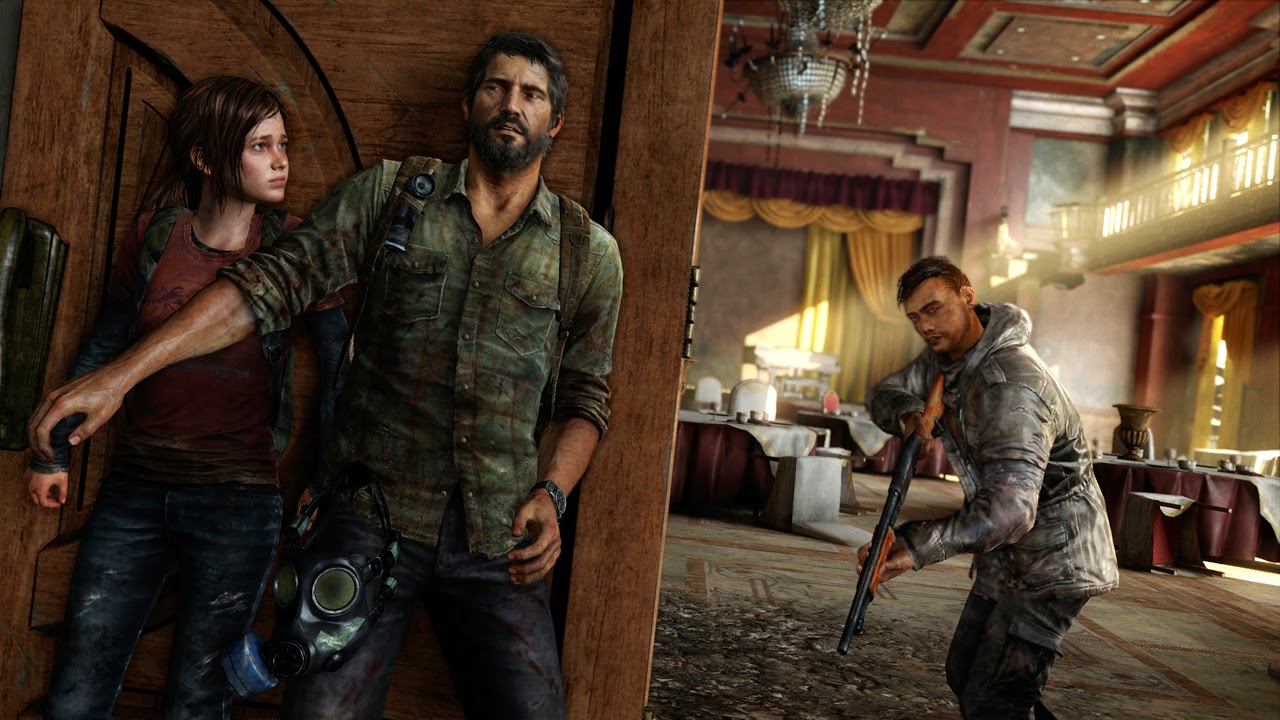
3. The Last of Us
The Last of Us is the reason I say to people they are missing out by not playing video games. It’s been hailed as the “HBO” of video games and I whole heartedly believe it is. It proves you can have cinema quality presentation while combining it with the interactivity of a video game. To me, it sums up the true potential of video games. They can tell a heartfelt story about characters you care for but also immerse you deeply through its interactive elements, something that still isn't standard in video game narratives. This game almost takes it for granted that the gameplay is rock-solid and shifts its focus to the writing and story. It’s a beautifully written and has expert voice acting. You only need to compare the voice acting in this game to the first Resident Evil title to see just how far video games have come. The Last of Us is a masterpiece that will be remembered for many years to come.

Have a look at the videos below and compare the voice acting and presentation of Resident Evil to The Last of Us .

Resident Evil (1996)

Last of Us (2013)

2. Super Mario 64
After all the praise I’ve given games for being arty and telling a top-notch story Super Mario 64 runs counter to that logic! There’s little to no story here accept rescue Princess Peach from Bowser. What Super Mario 64 is, is a shining example of a traditional video game. Collect the coins, collect the stars and beat the boss. It’s all here, everything you associate with video games. However, what makes Mario 64 so special is that it does all these aspects so well and it was one of the first to do so in 3D.  

There were other 3D games around at the time but none of them created a fully realised 3D world like this one. Crash Bandicoot was a 3D game but the levels were essentially lattice like corridors rather than a fully three dimensional environment. I remember my first time playing this game at a Toys 'R' Us promo kiosk and it completely blew my mind. I’d never experienced a 3D world you could run around so freely and easily. At the time it just wasn’t even something I thought possible or expected from the gaming world. The fact that one of the first open 3D world platformers is still one of the best, speaks volumes about how good this game is. The levels are incredibly varied, the puzzles are expertly designed and I’d recommend this game to anyone who enjoys video games.

1.The Legend of Zelda: Ocarina Of Time
OK so here it is my number one game of all time - The Legend of Zelda : Ocarina of Time. A huge open, long-form, action adventure game that excels at everything it touches. Again with this game Nintendo were introducing new ideas in the transition to 3D gaming. It was the first time lock-on targeting (then called "Z-Targeting") and context sensitive buttons were used. These ideas were so strong that they are still widely used today. I’m not sure how Nintendo struck gold with their first 3D iterations of games but struck gold they did. 

The art direction used for the characters and world design is stellar, the gameplay is gripping and the puzzles innovative. This game is unmatched when it comes to the variety of puzzles and diversity of actions. Even mini-games such as fishing are so good they could be fleshed out into their own games. This outstanding game is accompanied by the most memorable melodies you’ll ever hear and it gets my vote for best soundtrack on this list as well. Ocarina of Time is just as important today as it was back then. If for some reason you haven’t played this game, go out of your way to play it! It will be worth it.

So there you have it my top 25 games of all time hope you enjoyed reading it. Let us know some of your favourites in the comments section below and here's a few honourable mentions that crossed my mind.

Honourable Mentions
Super Mario World - Nintendo's most iconic 2D platformer.
Jak and Daxter - An excellent spiritual successor to Crash Bandicoot.
Final fantasy 10 - One of my favourite JRPGs.
Banjo Kazooie - A wonderful platformer from Rare.
Rayman Origins - An excellent modern game still flying the flag for 2D platformers.
Portal - An ingenious puzzle game as stated above.
Pokemon Red and blue  - Because you gotta catch em all!
The Walking Dead season 1 - Raises the bar for emotional story telling in games.
Tony Hawks Pro Skater 2 - The original fun and crazy extreme sports game.

Follow Dave Lamb on..
Twitter - @DaveLambs
Instagram - dave_lambs
Xbox One - DaveLambs
Contact on LinkedIn - www.linkedin.com/in/mrdlamb